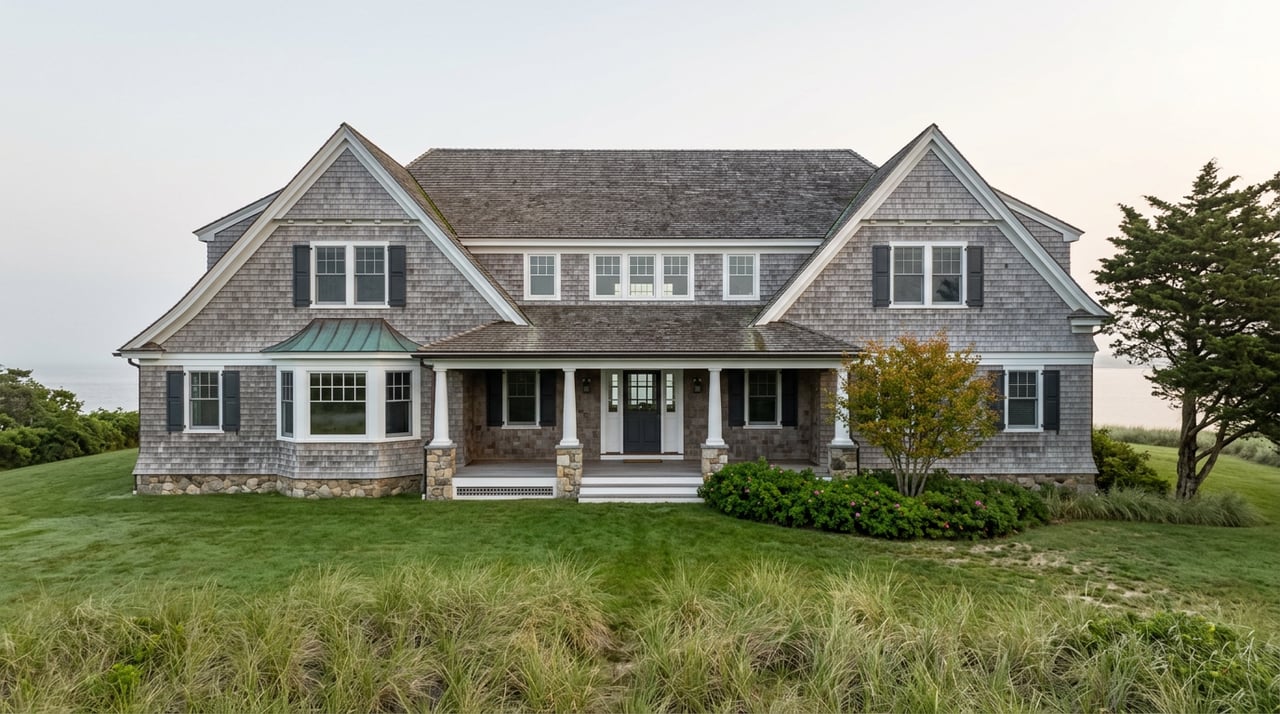
What happens to a bluff-top property in St. Joseph when Lake Michigan stops being calm?
That question rarely comes up during a September showing. The water is quiet, the beach below Lions Park has sand on it again, and the bluff itself looks like exactly what the listing photos promise: a settled, permanent thing. But a bluff is not a fixed feature the way a roofline or a foundation is. It moves in cycles tied to the lake's water level, and St. Joseph has its own zoning rules about what a homeowner can and cannot do to slow that movement. Buyers who evaluate a shoreline property based on how it looks in a single calm season are missing the part of the story that actually determines what they're buying.
The City Limits What You Can Build to Protect It
St. Joseph's zoning ordinance includes a Lake Bluff Scenic View Protection Overlay District, created specifically to limit how much development can alter the natural bluff face and the sightlines along it. The city's own planning language acknowledges the tradeoff directly: it points to the detrimental effects of seawalls and other shore protection structures built up and down the coast over many years in response to erosion. In plain terms, the city treats bluff hardening as something to be managed carefully, not something a homeowner can simply decide to do.
That caution has teeth. When erosion becomes severe enough to threaten a home, a property owner typically needs sign-off from more than one level of government before installing protection. Local approval is only the first layer. Depending on the scope of the work, permits from the Michigan Department of Environment, Great Lakes and Energy and, in some cases, the U.S. Army Corps of Engineers can also be required. That is not a same-season process. It is the kind of timeline that can stretch well past a single winter of bad storms, which is exactly when a property owner would most want the protection already in place.
For a buyer, this changes the question worth asking. It is not "does this bluff look stable." It is "if this bluff starts moving, what could I actually do about it, and how fast."
A Calm Bluff Doesn't Show You Its History
St. Joseph's shoreline has a longer memory than most buyers realize, and one of the more striking pieces of evidence for that sits below Lookout Park, south of Hilltop Road. Decades ago, as erosion threatened homes along that stretch, property owners piled roughly 150 junked cars along the base of the bluff, hoping the wreckage would act as a barrier against the waves. For years the debris sat buried and mostly forgotten. Then erosion in more recent years cut back into the bluff face far enough to expose it again, giving current residents a literal look at how past generations fought the same battle.
That story matters for reasons beyond curiosity. It is a reminder that what a bluff looks like on any given day is a single frame in a much longer film. The car graveyard exists because a past cycle of high water and wave action was severe enough that homeowners resorted to dumping automobiles into the lake. The current calm doesn't erase that history. It just means the cycle is somewhere else on its curve right now.
The Water Already Proved the Point This Year
If a buyer wanted a real-time demonstration of how quickly that curve can turn, 2026 provided one.
Lake Michigan's water level had been trending below its long-term average since October 2024, the first sustained below-average stretch in roughly a decade. Beaches recovered during that window, which is part of why a St. Joseph shoreline property might look particularly reassuring to a buyer touring homes this year. Then, in April 2026, the lake rose 13.4 inches in a single month, according to Wisconsin Coastal Resilience's tracking of Army Corps data. That is roughly triple the average April increase, driven by what regional monitors described as one of Wisconsin's wettest Aprils on record. By May, Lake Michigan had climbed above its long-term average for the first time since September 2024. Army Corps weekly readings from early September 2026 show levels still running five to eighteen inches higher than the same week a year earlier.
In other words, the exact window that made this year's bluffs look stable ended abruptly, in a matter of weeks, well within a single buying season. A researcher at Michigan State University who studies Great Lakes shorelines put it plainly in a June 2026 interview: this is the moment to prepare for the next high-water cycle, not evidence that the risk has passed. The same interview noted that armoring a bluff can create problems for neighboring properties by starving beaches downdrift of sand, which is part of why the city's ordinance treats hardening as a last resort rather than a routine option.
None of this means St. Joseph's waterfront is a bad place to buy. It means the property's relationship to the lake is dynamic, and a single showing captures only one point in that relationship.
What to Actually Ask Before You Make an Offer
A buyer comparing bluff-top or beachfront listings in St. Joseph is better served by asking about history and process than by relying on how the property presents on a calm day. Worth raising with a seller or their agent before writing an offer:
- Has this specific stretch of bluff experienced visible erosion, slumping, or tree loss in the past 10 to 15 years, and is there any documentation of it?
- Does the property already have a permitted seawall, revetment, or other shore protection, and if so, when was it approved and by which agencies?
- Where does the home sit relative to the Lake Bluff Scenic View Protection Overlay District boundary, and what does that mean for any future work on the bluff face?
- Has the seller had any conversations with the city, EGLE, or the Army Corps about erosion control, even informally?
- What vegetation or drainage management is currently in place on the bluff face, since both affect how quickly a slope responds to a high-water cycle?
A home with legally permitted protection already in place carries less uncertainty than a similar one without it, simply because the multi-agency approval process is largely already behind it. That is worth factoring into how two otherwise comparable bluff-top listings stack up against each other, even before either one shows a sign of trouble.
A Few Straight Answers
Does a calm beach mean the bluff behind it is stable? Not on its own. Beach recovery and bluff stability are related but not identical, and both respond to the same water level cycle on a lag. A wide beach in September 2026 reflects the water conditions of the past year or two, not a permanent state.
Can a new owner just build a seawall if erosion becomes a problem? Not automatically. St. Joseph's zoning discourages new hardening along the shoreline, and depending on the scope of the work, a homeowner may need approval from the state and potentially the Army Corps of Engineers in addition to the city. That process takes time.
Is Lake Michigan's water level currently rising or falling? As of early September 2026, levels are running five to eighteen inches higher than the same week in 2025 and are close to or slightly above the long-term average for the season, following a record jump in April. The broader pattern over the past several years has been a below-average stretch followed by a sharp reversal, which is the cycle buyers should plan around rather than the specific number on any given week.
A bluff-top address in St. Joseph can be a genuinely good decision. It just deserves the same due diligence as any other property with a variable that isn't visible from the curb. If you're comparing waterfront listings in St. Joseph and want a clear-eyed read on a specific property's history and its position relative to the city's protection overlay, Joy Schwarting can walk through what to look for before you write an offer. Schedule a consultation to talk through the specifics of the parcel you have in mind.